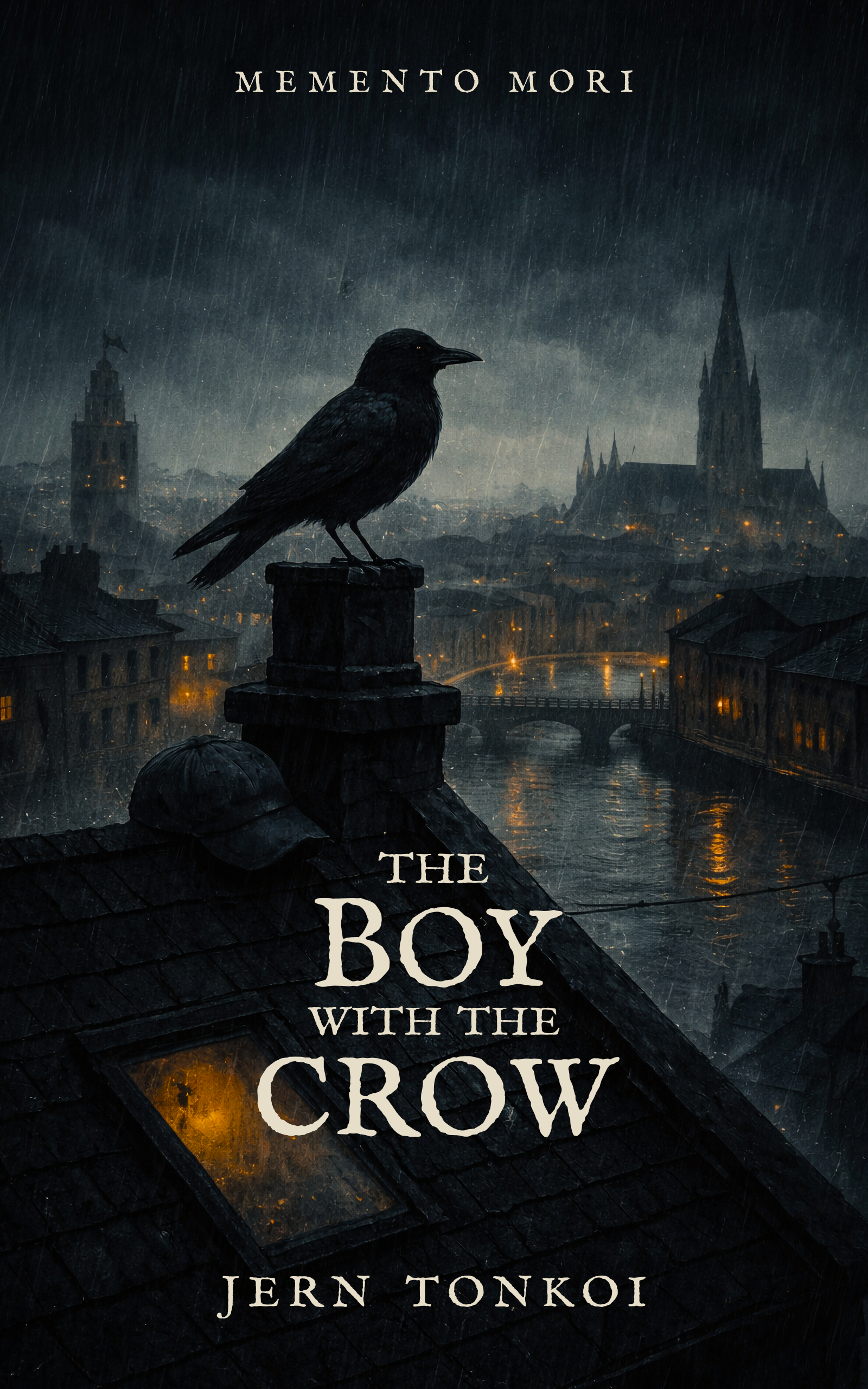
The Boy with the Crow
A Memento Mori Novel
Free Sample
Start reading instantly — no signup needed.
Blurb
A Cork coder can’t stay invisible when the River Lee gives up its dead.
In rain-soaked Cork, reclusive coder Mason Maloney lives alone in a cramped attic, chasing clean logic on a glowing screen while a human skull watches from the shelf above his monitor. He keeps his head down, his green cap low, and his past at arm’s length—until Cassandra, an art dealer from Dublin, is found dead in the river.
Mason’s plan is simple: stay invisible, stick to his small rituals, and avoid the questions he can’t answer. But Detective Sergeant Brianna Friday has a talent for prising at weak seams, and Tim Button—a visiting academic who can’t leave the scene alone—keeps turning up where Mason most needs distance. Then Arty Armitage steps back into Mason’s orbit, unnervingly composed and close enough to know exactly which hurts still run under the skin.
As the investigation tightens, Cork begins to feel like a closed room: whispers of ghosts, the glare of suspicion, and an art-and-money trail that refuses to stay local. Mason risks losing the fragile life he’s built—and the one thing he’s always relied on: control.
Content notes: strong language; explicit sex between men; moderate violence/peril.
Series: Book 1 of Memento Mori (can be read as a standalone).
Behind the Pages
No forgiveness cuts deeper than the kind you owe yourself.
Memento Mori was born from a single image: a rainy night, a young man sitting alone in a dim bedroom, talking to a skull as if it were the only soul who truly listened. The moment whispered of guilt, grief, and the hazy boundary between the living and the dead. From that one scene, Mason took shape—and the story began to take root, dark and unrelenting.
The inspiration found me while travelling through Ireland. I had a long stopover in Cork, a city that hums with contradictions. The River Lee winds through its heart like a silver thread, dividing and rejoining. The University College Cork nestles among the trees, its Gothic arches and shadowed courtyards carrying a quiet sort of dignity. On damp evenings, the city glows—streetlights reflected in wet cobblestones, church spires piercing low clouds. There’s a weight to the air there, the scent of rain and stone and older secrets that never quite wash away.
This is my third trilogy, but writing Mason pushed me well beyond my comfort zone. There were moments I found myself hesitating—small personal hurdles that mirrored his own quiet struggles. Mason is fragile, yet resilient; I often cheered him on as he stumbled through the dark. But there were times, more than I’d like to admit, when I wanted to reach through the page, still his restless mind, and simply hold him for a while.
Memento Mori wasn’t an easy story to write, but it was worth every step. I grew as a writer—and as a person—and the story became everything, and more, than I had first imagined on the page.
I’m often asked what genre Memento Mori belongs to. On the surface, it’s a murder mystery—a tangle of secrets, lies, and quiet reckonings. But at its core, it’s a story of love—not the simple kind, but the kind that binds the broken together, that grows in the cracks, that turns strangers into family.
Because in the end, Memento Mori isn’t just a reminder that we die.
It’s a reminder that we live—and that even in the darkest corners, there is always something left worth saving.
Jern Tonkoi
Reviews
The Boy with the Crow is a rain-soaked, atmospheric mystery that blends a compelling whodunit with deep emotional undercurrents. ... This is not a romance, despite the presence of desire, attachment, and intimacy. Instead, the novel explores love in its most ambiguous forms—transactional, unspoken, misdirected, and obsessive—showing how easily care can blur into control, and affection into something far more dangerous. Dark, emotionally intense, and steeped in atmosphere, The Boy with the Crow is a mystery that lingers, less interested in comfort or resolution than in the uneasy spaces between people.
This is the second book I’ve read by this author, and it had me hooked nearly as fast as the first book I read by her. It’s getting four stars only because I predicted multiple significant plot points very early on, though this did not take away from the thrills I felt as the book went on. The characters are well developed, and the complicated web that ties them all together was fun to unravel. I’m excited for the next book in this series to release.
Read-alikes
- The Dublin Murder Squad: In the Woods — Tana French Crime — Psychological Noir
Shared Irish setting, psychological focus, and a noir tone where interior lives matter as much as the crime.
- The Paying Guests — Sarah Waters Crime — Historical
Aligns on queer adult audience, slow-burn tension, and the pressure of secrets within closed environments.
- The Talented Mr Ripley — Patricia Highsmith Crime — Psychological
Matches the focus on control, unreliable interiors, and a protagonist navigating suspicion without clean moral ground.
- Shuggie Bain — Douglas Stuart Literary — Contemporary
Shares grief-threaded character drama and a grounded, unsentimental voice aimed at adult literary readers.
- The Shadow District — Arnaldur Indriðason Crime — Nordic Noir
Comparable noir mood, slow investigative pressure, and a setting that feels claustrophobic and haunted.
- Black Water Rising — Attica Locke Crime — Noir
Echoes reluctant involvement, personal risk, and a noir lens where community and suspicion close in.